Larry Sultan, John Rubin, and Harrell Fletcher, People in Real Life, July-September, 1997, Stoneridge Mall, Pleasanton, CA
Larry Sultan, John Rubin, and Harrell Fletcher, People in Real Life, July-September, 1997, Stoneridge Mall, Pleasanton, CA
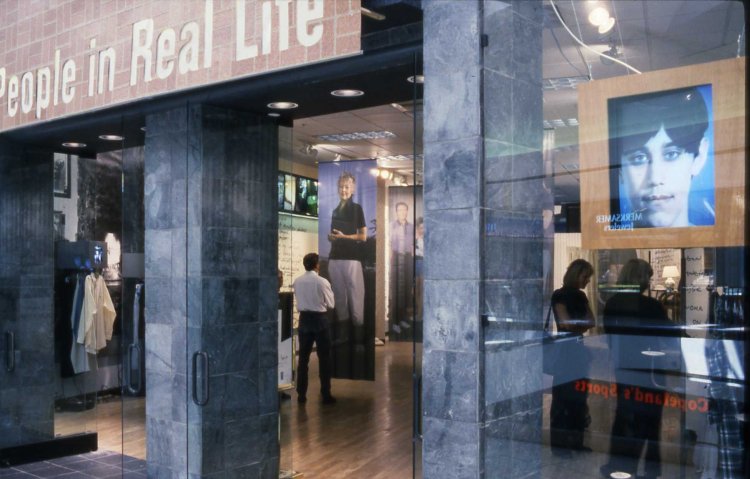
Artists Jon Rubin, Harrell Fletcher, and Larry Sultan collaborated with Dublin Fine Arts Foundation to examine “mall culture” through an artists’ residency in an empty store space at Stoneridge Mall in Pleasanton, California. Their residency culminated with the installation, “People in Real Life,” which was visited by an estimated 14,000 people over a six-week period. Most of the visitors were not art patrons, but were at the mall to shop and entered the store out of curiosity. Some came repeatedly.
In the cities of Dublin and Pleasanton (both in Alameda County, California), as in many suburban communities, the retail mall is the hub of communities’ social, cultural, and public life. The artists sought to develop a new language for creating public art in this environment. Over two months, they spent a minimum of two days per week at the mall, meeting and talking to community members. Ultimately, they chose five people–mall employees and visitors—whose stories and possessions became the focal point for the installation that was composed of video, photography, sound, text, and mock products.